
Product details
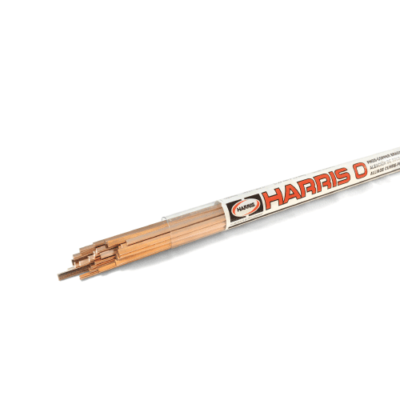
Low Fuming Bronze 15 (Bare) Brazing Rod HARRIS
Low Fuming Bronze 15 (Bare), also known as Harris 15 Low Fuming Bronze, is a copper-zinc brazing rod primarily developed for brazing steel and selected cast iron grades, including malleable and grey iron. It may also be used for copper joining, although care must be taken due to its higher operating temperature to avoid overheating the copper base metal.
This alloy is commonly classified as a braze-welding rod because it exhibits minimal capillary action during brazing. As a result, it is most suitable for lap, tee, and butt joint configurations. Butt joints generally require beveled edge preparation to allow proper filler metal placement and full penetration to the joint root.
During operation, base metals are heated to brazing temperature and the filler rod is manually deposited along the joint using oxy-fuel brazing techniques.
Key Benefits
Designed primarily for brazing steel and selected cast irons
Suitable for braze-welding structural and repair joints
Minimal capillary action supports controlled filler placement
Works well for lap, tee, and butt joint configurations
Compatible with oxy-fuel brazing operations
Available in multiple supply forms for varied applications
Specifications
Product Name: Low Fuming Bronze 15 (Bare)
Product Type: Copper-Zinc Brazing Rod
Application Method: Oxy-fuel brazing and braze-welding
Suitable Materials: Steel, malleable iron, grey cast iron, and copper with heat control
Joint Compatibility: Lap, tee, and butt joints with edge preparation
Solidus Temperature: 1590°F (866°C)
Liquidus Temperature: 1630°F (888°C)
Brazing Range: 1670°F to 1750°F (910°C to 955°C)
Available Forms: Straight rods, preformed rings, and spooled wire for semi-automated applications
Applications
Steel fabrication and repair brazing
Cast iron component repair work
Industrial maintenance and structural repair
Oxy-fuel brazing and braze-welding operations
Workshop and field repair applications
FAQs
What materials can Low Fuming Bronze 15 be used on?
It is mainly used for steel and selected cast iron grades, and can also be applied to copper with proper heat control.
Why is it called braze-welding alloy?
Because it has minimal capillary action and is manually deposited similar to welding filler material.
What joint types are suitable?
Lap, tee, and prepared butt joints are recommended.
What heating method is used with this alloy?
It is used primarily with oxy-fuel brazing processes.