

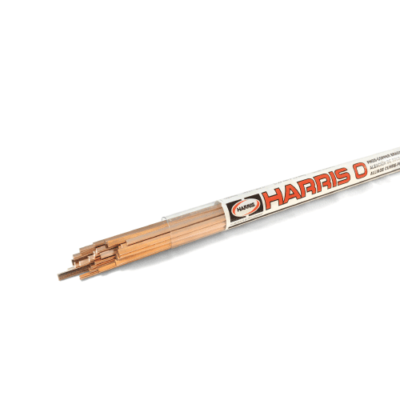
Product details
Harris 0 Brazing Alloy HARRIS
Harris 0 is a cost-effective brazing alloy primarily developed for copper-to-copper connections. It flows quickly at brazing temperature, making it suitable for tight joint tolerances typically below 0.005 inch. Because of its performance and economy, it is commonly selected for copper brazing operations.
The alloy can also be used for brazing brass components, although operators should carefully control heat input and apply Harris Stay Silv® white brazing flux to ensure proper results. Harris 0 is widely used in HVAC and refrigeration installations where reliable copper joints are required.
This alloy is not recommended for steel or other ferrous metals because phosphorus in the alloy can form brittle compounds with ferrous base materials.
Key Benefits
Economical alloy for copper brazing applications
Fast alloy flow suitable for tight joint tolerances
Provides strong copper-to-copper joints
Can be used on brass with proper flux application
Widely used in HVAC and refrigeration brazing work
Offers dependable performance for production and repair tasks
Specifications
Product Name: Harris 0
Product Type: Copper-Phosphorus Brazing Alloy
Suitable Materials: Copper and brass
Self-Fluxing Feature: Yes, on copper joints
Not Suitable For: Steel and ferrous metals
Chemical Composition: Copper remainder, Phosphorus 7.1%, Other elements total 0.15%
Solidus Temperature: 1310°F (710°C)
Liquidus Temperature: 1460°F (793°C)
Brazing Range: 1345°F to 1500°F (730°C to 816°C)
Electrical Conductivity: 9.9% IACS
Electrical Resistivity: 19.2
Applications
Copper tubing and pipe brazing
HVAC and refrigeration installations
Copper plumbing assemblies
Brass component brazing with flux use
Maintenance and fabrication brazing operations
FAQs
Is Harris 0 self-fluxing on copper joints?
Yes, phosphorus content allows self-fluxing on copper-to-copper connections.
Can it be used on brass?
Yes, but proper heat control and use of Stay Silv® white brazing flux are recommended.
Can it be used on steel?
No, it is not recommended for ferrous metals due to brittle compound formation.
Why is tight joint clearance important?
The alloy flows quickly and performs best in close-fitting joints.